

Table of Contents
- Why Niche Perfumes Fade Quickly: The Real Causes
- How Skin Type and Dry Skin Affect Fragrance Longevity
- Fragrance Concentration Guide: Eau de Toilette, Eau de Parfum, and Perfume Oil
- Note Families and Wear Time: Why Citrus Fades First
- How to Make Perfume Last Longer on Skin: Application and Layering
- Perfume Storage Best Practices for Hot Climates
- A Controlled Wear Test to Troubleshoot Fading
- Conclusion: Setting Realistic Expectations for Niche Fragrance
- Frequently Asked Questions
Last Updated: October 6, 2026
Why Niche Perfumes Fade Quickly: The Real Causes
Most people assume a fragrance that disappears by lunchtime is a weak formula. In reality, why do niche perfumes fade quickly is rarely about quality at all. Perfume performance is a physical process governed by evaporation, skin condition, and how your nose adapts to a scent it has been smelling for hours. At LaScent, we build our fragrances around high-quality, stable fragrance oils.
The first thing to understand is that evaporation is not a fault. It is the mechanism by which perfume works.
Perception Versus Actual Fading
Olfactory adaptation is the brain's tendency to stop registering a smell it is exposed to continuously, which makes a fragrance feel faded long before its molecules have actually left your skin.
This distinction matters more than any other point in this guide. A niche perfume can still be projecting strongly to everyone around you while you smell almost nothing. Your nose simply stopped reporting it. The common advice to "spray more" is often the wrong fix, because it adds intensity for others while doing nothing for your own perception.
A useful test: ask someone standing a metre away whether they can still smell you. If they can, the fragrance has not faded. You have adapted to it.
How Skin Type and Dry Skin Affect Fragrance Longevity
Dry skin is the single most common reason a fragrance underperforms. Fragrance molecules need oil and moisture to cling to; on dry, dehydrated skin they evaporate faster and the scent disappears sooner. Oily skin holds scent noticeably longer, while balanced skin sits somewhere in between.
If your skin is dry, this is the most fixable problem on the list. A fragrance applied to well-moisturised skin has something to anchor to, and the difference in wear time is often dramatic rather than subtle. Skin chemistry also plays a role: your natural pH and body temperature influence how a composition unfolds, which is why the same bottle can behave differently on two people.
Fragrance Concentration Guide: Eau de Toilette, Eau de Parfum, and Perfume Oil
Fragrance concentration is the proportion of aromatic oil in a formula, and it is the clearest predictor of how long a scent will last. The higher the concentration, the slower the evaporation and the longer the wear.
| Type | Typical Oil Concentration | Expected Wear Time | Best For |
|---|---|---|---|
| Eau de Toilette | Lower | 3-5 hours | Daytime, warm weather |
| Eau de Parfum | Medium | 5-8 hours | Office, evenings |
| Perfume Oil | Highest | 8+ hours | Long wear, close projection |
Perfume oil is the format most people overlook. Because it contains little to no alcohol, it does not flash off the skin the way a spray does, and it sits closer to the body. For anyone who wants a subtle, enduring presence rather than a loud trail, an oil-based format is usually the smarter choice.
Note Families and Wear Time: Why Citrus Fades First
Citrus notes fade first because their molecules are small and volatile, meaning they evaporate at low temperatures. This is chemistry, not a manufacturing shortcut. Top notes such as bergamot, lemon, and neroli are designed to be the opening act, and they are meant to leave quickly.
The structure of a fragrance runs in three stages:
- Top notes: light, fresh, and citrus-led, lasting minutes to an hour
- Middle notes: florals, spices, and herbs, forming the heart of the scent
- Base notes: musk, amber, oud, and woods, which are heavy and slow to evaporate
Heavy base notes are what give a fragrance its staying power. If you want a scent that survives a full working day, look for compositions built on musk, amber, or woods rather than those led by fresh and citrus accords. That is also why a fragrance can smell completely different after an hour: you are no longer smelling the opening, you are smelling the dry-down.
How to Make Perfume Last Longer on Skin: Application and Layering
Knowing how to make perfume last longer on skin comes down to three things: where you spray, what you spray onto, and what you layer underneath. Technique matters as much as the bottle.
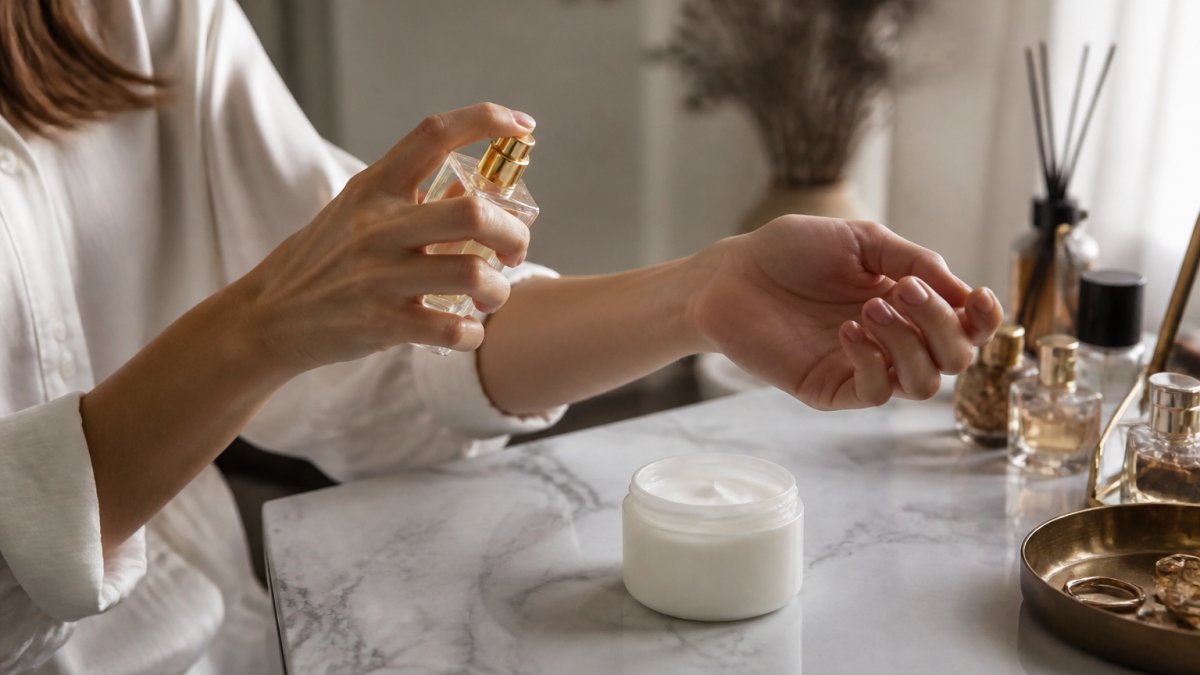
- Start with moisturised skin. Apply fragrance within a few minutes of moisturising, while the skin is still supple.
- Target pulse points. Wrists, the base of the throat, behind the ears, and the inner elbows are warmer and release scent gradually.
- Spray from a short distance. Hold the bottle 10-15 centimetres from the skin and spray once per point.
- Never rub your wrists together. Friction and heat break down the top notes and shorten the life of the composition.
- Layer deliberately. Use a matching body oil or an unscented base, then build the fragrance on top.
Fabric, Hair, and Skin: Application Trade-Offs
Skin is not the only surface, and each option carries a trade-off. Fabric holds fragrance far longer than skin because fibres trap the oils, but some coloured formulas can stain delicate materials, so test on an inconspicuous area first. Hair carries scent beautifully and releases it with movement, though alcohol-heavy sprays can dry the strands over time. Perfume oil applied to the ends of the hair is the gentler route.
The honest summary: skin gives you the most natural development, fabric gives you the longest wear, and hair gives you the best movement. Many people use all three.
Perfume Storage Best Practices for Hot Climates
Heat, light, and air are the three enemies of a fragrance, and all three are amplified in a warm climate. Perfume storage best practices start with keeping bottles away from bathroom windowsills and car gloveboxes, where temperature swings are severe.
Store bottles upright, tightly closed, in their original box if you still have it, inside a dark cupboard at a stable temperature. A bedroom wardrobe works well. Refrigeration is sometimes recommended, but only if the bottle stays there permanently; moving it in and out causes condensation and does more harm than good.
Age and batch also matter. A fragrance that has sat open for years will smell different from a fresh bottle of the same formula, and this is normal rather than a defect.
A Controlled Wear Test to Troubleshoot Fading
Guessing is the reason most people never solve this problem. Run a structured wear test instead, changing one variable at a time so you can actually identify the cause.
- Day 1: Apply to bare, unmoisturised skin. Note the hour the scent disappears to you.
- Day 2: Apply the same amount to moisturised skin. Compare the timing.
- Day 3: Apply to fabric instead of skin. Note the difference.
- Day 4: Ask a friend to confirm whether they can still detect the scent at hours three, five, and eight.
Most people find the answer within a week. If the scent lasts on fabric but not on skin, the issue is skin condition. If it fades everywhere at the same rate, the concentration or note structure is simply not built for long wear.
Conclusion: Setting Realistic Expectations for Niche Fragrance
Niche perfumery is not designed to shout. Many artisanal compositions favour restraint over projection, which means a close-wearing scent is often working exactly as intended. Expecting eight hours of strong projection from a delicate citrus composition sets you up to be disappointed by something that is performing correctly.
The niche longevity myth
A persistent belief holds that niche automatically means higher concentration, richer materials, and longer wear. In practice, niche status describes how a fragrance is made and sold, smaller houses, less mass-market distribution, often more experimental briefs, not a guaranteed performance tier. Two niche releases at the same price can sit at opposite ends of the longevity spectrum, and a well-built designer eau de parfum can outlast a niche eau de toilette without difficulty.
This is why artistic intent and performance claims should be read separately. A perfumer may deliberately build a fragrance that whispers for three hours because that is the experience they wanted to create. That is a design decision, not a defect, but it is also not a promise of endurance, and no marketing copy changes the chemistry.
What you can actually control
The variables that decide how long a fragrance lasts on you are mostly on your side of the bottle:
- Skin condition. Moisturised skin holds scent longer than dry skin. This is the single most fixable factor.
- Application. Pulse points, a short spray distance, and no rubbing preserve the composition's structure.
- Surface choice. Fabric and hair extend wear; skin gives the most natural development.
- Storage. Heat, light, and air degrade a formula over time, and warm climates accelerate the process.
- Realistic note expectations. A citrus-led opening is meant to leave. A musk, amber, or oud base is meant to stay.
Batch, age, and the bottle you already own
Before blaming a fragrance, consider its history. A bottle that has sat open for years, or spent a summer near a window, will smell different from a fresh one of the same formula. Top notes are usually the first to shift, which is why an old bottle can open sharp or flat while the dry-down still reads correctly.
If you suspect a bottle has turned, compare it against a known-fresh sample of the same composition before drawing conclusions. If the fresh sample performs well and the older one does not, storage and age are the likely cause. If both behave the same way, the formula simply wears the way it wears.
The honest summary
Most people who believe their niche perfume fades too quickly are dealing with one of four things: dry skin, a light note structure, olfactory adaptation, or a bottle that has aged. None of these are reasons to abandon niche perfumery. They are reasons to test deliberately, apply thoughtfully, and choose compositions whose base notes match the wear time you actually want.
At LaScent, we build our fragrances around high-quality, stable fragrance oils and craft them for a balanced, enduring presence, with artistic packaging that reflects the same care. If you want a scent that stays close and lasts, our collection is designed for exactly that. Shop now.
Frequently Asked Questions
Why does my perfume fade so quickly?
Fading usually comes from a combination of factors rather than one single cause. Dry or dehydrated skin absorbs fragrance oils faster, light top notes like citrus evaporate within the first hour, and high temperatures speed up volatility. Application technique matters too: spraying on dry skin without a moisturizer base, or applying to areas with poor circulation, shortens wear time. Storage in direct sunlight or a hot bathroom also degrades the formula over months.
Does skin type affect how long perfume lasts?
Yes. Oily skin tends to hold fragrance longer because oils slow evaporation, while dry and dehydrated skin lets scent dissipate faster. If your skin is dry, apply an unscented moisturizer or a matching body lotion before spraying. This gives the fragrance oils something to bind to and can noticeably extend wear time. Skin chemistry also varies person to person, which is why the same perfume can behave differently on two people.
Are niche perfumes designed to be subtle rather than long-lasting?
Not necessarily. Many niche houses use high concentrations of stable fragrance oils, but they often favor natural ingredients and complex note structures over synthetic fixatives that extend wear. This can make a scent feel closer to the skin and fade sooner in perception, even when the oils themselves are high quality. A perfume can be both refined and enduring; concentration, base notes, and application all shape how long it stays.
What is the difference between perfume concentration and longevity?
Concentration refers to how much fragrance oil is dissolved in the alcohol or carrier, measured as eau de toilette, eau de parfum, or perfume oil. Longevity is how long the scent actually lasts on your skin. A higher concentration usually means longer wear, but not always: note families, skin type, heat, and humidity all influence performance. Two eau de parfums at the same concentration can wear very differently depending on their base notes.